Affiliate links on Android Authority may earn us a commission. Learn more.
Android enthusiasts have lived with foldables ever since Chinese company Royole released the FlexPai in December 2018. We’ve endured early hinge debacles, catastrophic inner-display peels, and awkward outer screens as companies like Samsung, OPPO, Xiaomi, and Google worked to refine the very idea of a folding phone.
Apple has sat quietly on the sidelines while Android brands experimented, and while the company is over seven years late to the category, from my brief time with the new iPhone Duo, it might just have a winner in its hands.
I went into my iPhone Duo briefing today having read the full spec sheet, and its 254g weight particularly stood out to me. That’s heavier than the iPhone 18 Pro Max (249g), which itself is the heaviest non-folding iPhone Apple has built to date. I expected a heavy brick of a phone, as all Pro Max iPhones have been, but the iPhone Duo left me pleasantly surprised.
The iPhone Duo feels dense and robust in the hand, but since most of the weight is concentrated in your palm, it doesn’t feel heavy or unwieldy like a top-heavy, large phone that hangs outside your hand.
The dense feeling is a fair contrast to the Samsung Galaxy Z Fold 8, the iPhone Duo’s closest competitor, which weighs just 201g. The Fold 8 feels light and flickable (in a good way), while the iPhone Duo demands a bit more attention and energy to handle. While I wouldn’t dare drop either foldable, the iPhone Duo’s heft gave me more confidence that it would survive an accidental drop without a case than the Fold 8.
When unfolded, the iPhone Duo is very thin and reminds me a lot of the iPhone Air. It’s easy to see how Apple used the iPhone Air as a stepping stone to reach the Duo’s design.
Opening and shutting the iPhone Duo requires a bit of intention, as the hinge feels smooth yet solid. The hinge mechanism has enough tension to allow the Duo to stop precisely at any angle within its folding range without any give, something that was missing from the Galaxy Z Fold 8, which could only stop at fully open or fully closed positions.
I love that the iPhone Duo has a very satisfying soft “thud” when you close it shut, thanks to magnets along the frame edge. You can just about feel the magnets working to keep the display folded shut.
Apple has engineered a fine balance, since the phone remains easy to open, too. The beveled frame has its role to play here, though I am not a big fan of the pointy left corners (when closed) — I can imagine them digging into my palm over long-term use. These corners could have been rounded off a little more, as they are on the Pixel 11 Pro Fold and the OnePlus Open.
Perfecting the folding action is the dreamy opening-and-closing transition animation that Apple has proudly created for the Duo. It looked dreamy on stage during Apple’s keynote, and it was just as impressive when I saw it in person.
I do feel the animation could get old and overbearing once you’ve owned the Duo and opened and closed it a hundred times, but the honeymoon period is very sweet here. I have no doubts that Android brands will copy this transition animation, as it definitely adds a touch of opulence to a folding phone’s primary action.
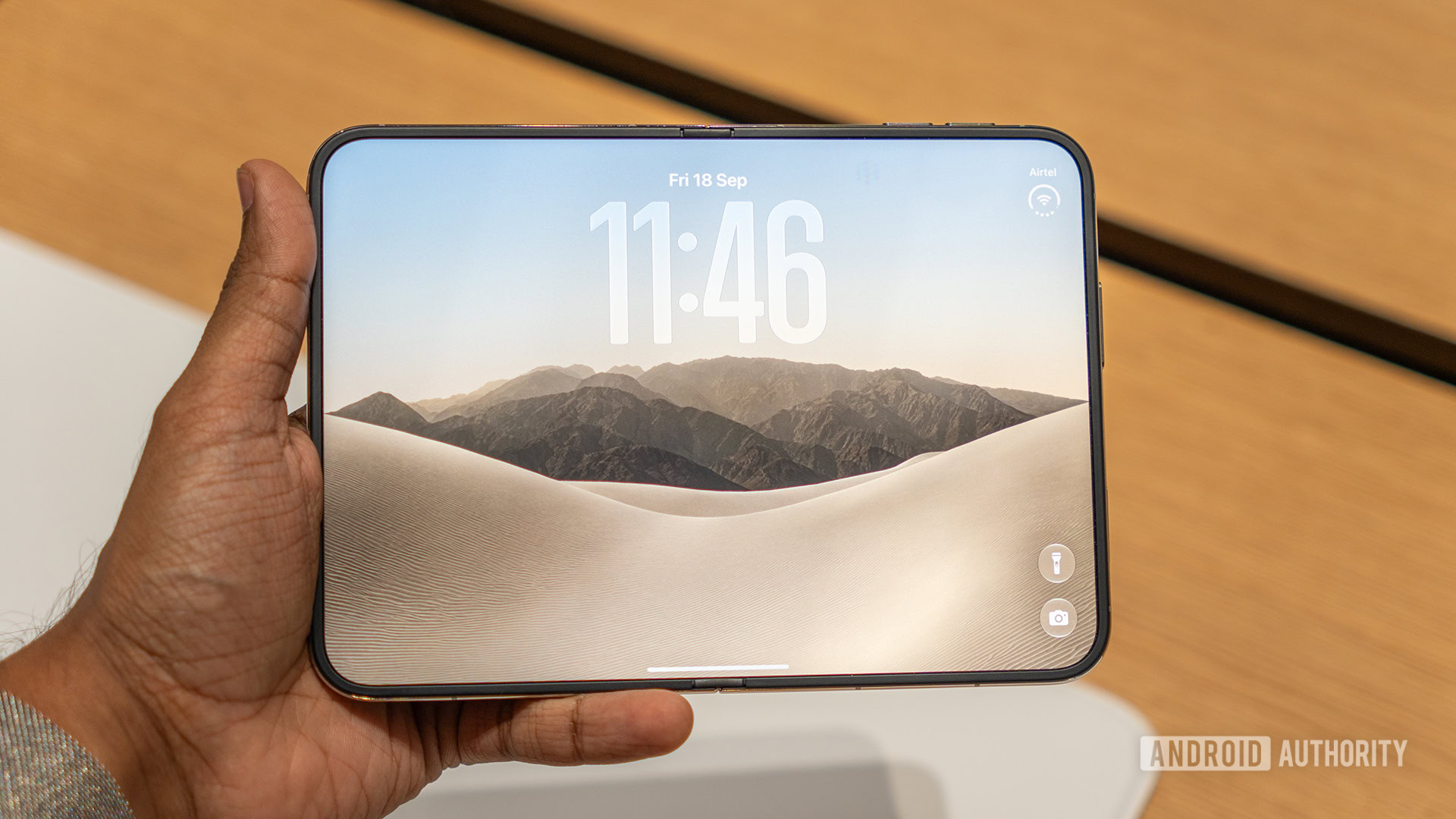
The star of the show on the iPhone Duo is the 7.6-inch Super Retina XDR folding display with a 1.42:1 aspect ratio, with its near-creaseless design being its biggest highlight. When viewed head-on, the crease is not visible at all. In fact, it’s also very difficult to spot at extreme angles, and I could only observe the crease when I held the Duo much farther away and deliberately shifted it to an extreme viewing angle.
A good part of the credit here goes to the nano-textured matte-finish layer on the folding display, which is rather ingenious on Apple’s part. The matte layer does an excellent job of diffusing light and reducing reflections, making the crease very difficult to spot. It does such a good job that it makes me jealous that Android brands haven’t thought of this solution over the past eight generations, and I bet it’s another one of those features they take inspiration from the iPhone Duo for their future foldable flagships.
The inner folding display is not perfect, though. If you’ve never seen a matte display before, it will take some getting used to, as the colors may look a little washed out and less punchy than on a glossy, reflective display.
While the crease is practically invisible, the under-display camera on the inner display is a lot more visible. You can fairly easily spot the shift in display pixel density where the camera is — the close-up shots you see here exaggerate the effect, but it’s visible to the naked eye as well.
I could only take one photo with the under-display camera, and it had the typical softness I’ve seen in under-display cameras before. There’s definitely more testing to be done, but the characteristics are right on par, so you’re more likely to use it for casual FaceTime or video calls rather than selfies or portraits.
The 5.4-inch Super Retina XDR cover display has the same 1:1.42 aspect ratio. There’s no matte layer here, so it’s much more recognizable as a typical iPhone display with punchy colors. Yet, because it is a new aspect ratio for Apple, the company has shifted several iOS design elements to the right edge to better use the screen real estate, thereby retaining an overall air of novelty.
In my limited hands-on time, I found that the navigation elements on the right edge were not easy to reach one-handed when I held the phone in my left hand, and the wide aspect ratio doesn’t help here either. There’s no toggle in iOS to shift these to the left edge (unless I’m mistaken), and I hope that Apple adds them in a future software update.
Wrapping up my thoughts with some more observations: the volume buttons on the top edge of the frame may take some getting used to, the lack of an Action button is noticeable, and the stereo speaker setup looks better executed than Samsung’s Fold 8. I’m also glad to see MagSafe compatibility here.
Multitasking for now seems to be limited to pairs of two apps only, and that too, only in landscape orientation on the inner display. It will also be interesting to see how apps adapt to the new folding form factor and whether they do so better than on Android.
For now, I am very excited about the iPhone Duo. It’s a paradigm shift moment for the iPhone, and with it, it will pull the broader Android market along. We’re seeing more Android brands open up to the idea of wide foldables, and even wide phones (non-foldable). Customers also seem receptive to the idea of a wide foldable, more so than they have been for large book-style foldables and flip-style clamshell foldables. There’s also no doubt that we’ll see app developers explore foldable-specific tweaks and layouts, and hopefully, these reach the other side of the river too.
The iPhone Duo is not the first foldable to hit the market, but based on everything I’ve experienced with the phone so far, I am very confident it will be one of the most impactful ones. That’s good news for Android foldable fans, too, and I can’t wait to see how the Android market reacts to some solid competition from Apple.
Thank you for being part of our community. Read our Comment Policy before posting.