Affiliate links on Android Authority may earn us a commission. Learn more.
I’m one of the bigger Motorola fans at Android Authority. If nothing else, I’ve spent the most time with a Moto phone in my pocket, ranging from several generations of the dirt-cheap Moto G to the recent heights of the ultra-premium (and Ultra-branded) Motorola Razr Ultra. There’s just something about the clean Android experience and fun Pantone colors that has always spoken to me; what can I say?
In that time, though, I’ve watched Motorola’s Edge series go through the wringer. I remember when it first rolled out as a flagship, only to become an affordable flagship-style option a year or two later, and before finally settling as a sub-$600 mid-ranger. And yet, there was still plenty to like about the Edge, even at its cheaper price point.
Now, I’m not so sure. I’ve spent months with the Motorola Edge (2026), and I can’t help but question almost everything about it. Buckle up, it’s going to be a bumpy ride.
Before I go poking holes in Motorola’s balloon, I have to say I like everything about the design of the Edge (2026). It’s clean, simple, and fits comfortably in my hand — something that still doesn’t happen very often, even though smaller displays have become more popular. And honestly, I think the design does a lot of heavy lifting when it comes to keeping the Motorola Edge (2026) in my pocket. If it didn’t look so good or fit so nicely, I’d have ditched it by now.
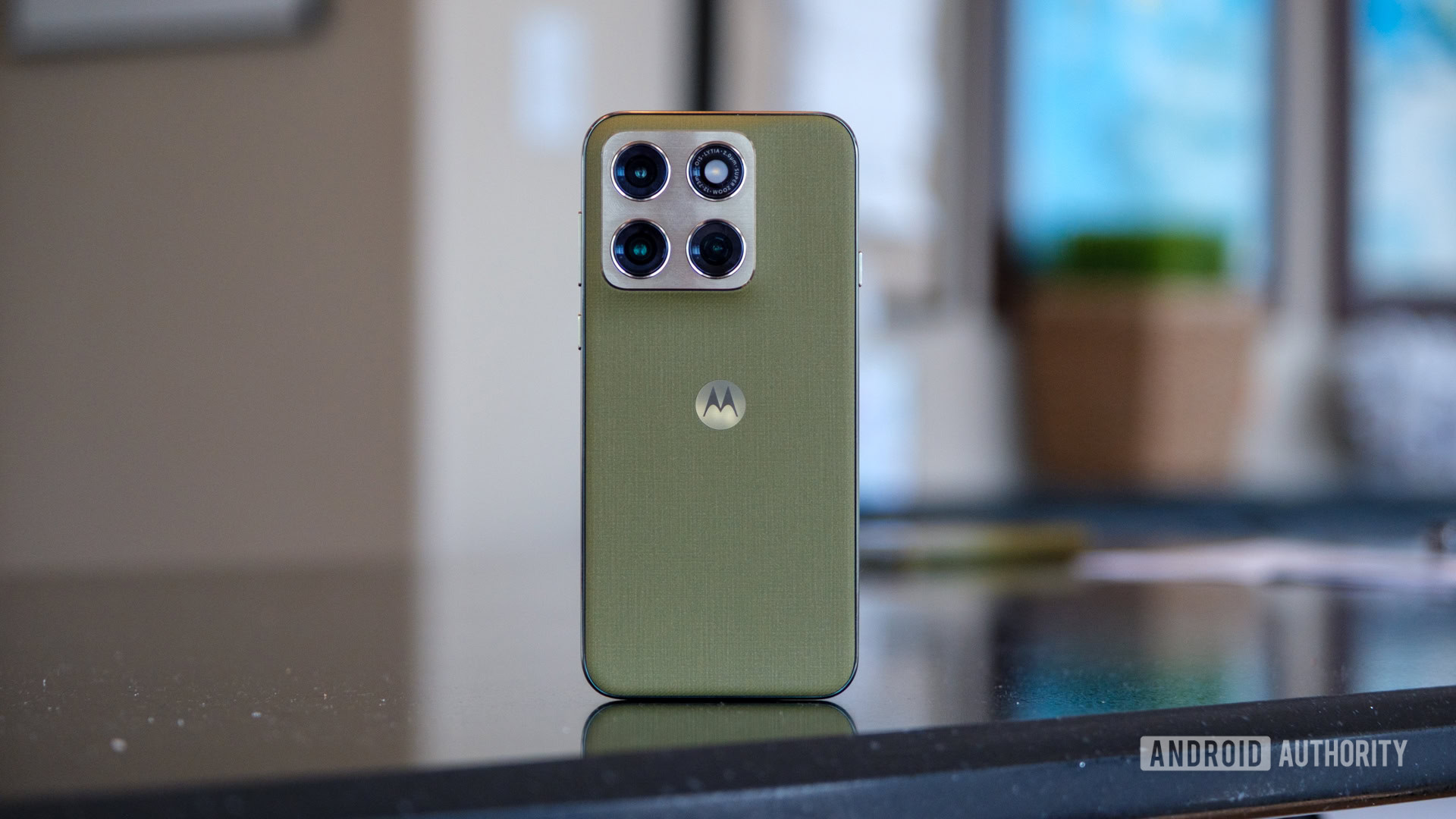
What, exactly, looks so good? Motorola and Pantone have once again nailed their color choices. The Martini Olive finish I received feels premium, pairing a woven back panel with a slightly rounded frame that’s brushed to look like metal. It’s not — the frame is plastic — but it certainly fooled me the first time I picked up the Edge (2026), and it still feels good after all this time. In fact, it still feels enough like metal to keep fooling me. The brushed gold-like texture carries over to the camera bump, which is big, square, and unmistakably Motorola.
The overall look is almost (and I do mean almost) as good as Motorola’s other Martini Olive option, the Motorola Signature. That phone actually has an aluminum frame and tougher display glass, and it feels stunning in the hand. Too bad it’ll never come stateside — a move that I think is a mistake when the Edge (2026) is so decidedly mid-range.
Anyway, my appreciation of the Edge (2026) isn’t purely aesthetic. Its compact size represents a massive (get it?) departure from its predecessors. The Edge still isn’t smaller than a closed Razr (2026), but it’s smaller than any traditional Moto. I’d describe the Edge (2026) as a complete 180-degree flip from the Edge (2025), which centered around a huge 6.7-inch pOLED panel. This version shrinks to a 6.3-inch Extreme AMOLED, and I actually feel like I can reach all three buttons without doing hand gymnastics.
I no longer feel like I’m straining to power the phone on, bump the volume up or down, or press the Moto AI key — at least, that’s how I’d feel if I ever used hardware-based AI triggers. Unfortunately, you can’t program the AI Key away from Moto AI either; you can only toggle it on or off. Honestly, I wish Motorola had copied Apple’s Action Button; I’d love to set it up as a volume toggle or a camera trigger.
Also, while I like the Martini Olive color that Motorola and Pantone settled on, I’m a little surprised it’s the only color option. I like fun phones, but I know plenty of people who would much rather have a black, gray, or white slab to pull out of their pocket — especially if they’re just going to put it in a case anyway. The woven texture probably won’t be for everyone, either, as it doesn’t really add any grip.
What will be for everyone is that you could get away without putting the Edge (2026) in a case if you didn’t want to. It’s a tough cookie, pairing IP68 and IP69 ratings with MIL-STD 810H drop protection. I’m still disappointed by the use of plastic pretty much everywhere, and the Gorilla Glass 7i display is good, more than great, but it was reassuring to take this phone for a few days at the beach without a second thought.
The 6.3-inch AMOLED panel also ensured I could use the Edge (2026) at a bright, sunny beach, and not just because it was easier to block the glare given the smaller footprint. For whatever reason, Motorola decided to pump its pocket-sized mid-ranger with 5,200 nits of peak brightness, which is more than enough. You’ll rarely hit that full brightness, but the Edge (2026) is plenty visible even at three-quarter strength.
I was also impressed by the Super HD (2,640 x 1,216) resolution, which was plenty sharp for streaming World Cup games when I couldn’t make it to a watch party. I turned to the Edge (2026) for a handful of group stage games and never felt like I was missing the action despite the tiny display. The dual Dolby Atmos speakers carried their weight, too, though I preferred them for streaming Spotify rather than suffering through soccer analysis from Alexi Lalas. Either way, they got loud and punchy without feeling mushy, which worked for me.
All told, if I were buying the Motorola Edge (2026) purely for its design, I’d be first in line. I’d pick it up, put my SIM in it, and keep it there for as long as I can. The problem, however, is that I’d actually have to use the Edge (2026), which is a less enticing proposition.
When I first looked at the spec sheet for the Motorola Edge (2026), I thought to myself, “This is fine.” I wasn’t blown away, but I picked out the MediaTek Dimensity 7450 as an expected annual upgrade and noted the 60W TurboPower charging should be pretty quick. Then I refreshed myself on the previous Motorola Edge (2025) and realized the new version isn’t as much of an upgrade as it seems.
For starters, the newer chipset is the only real upgrade. The 8GB of base RAM stayed the same, only this time it’s paired with 128GB of base storage instead of 256GB — an odd choice when there’s no slot for a microSD card. The 5,000mAh battery is also smaller than before — the 2025 version packed 5,200mAh — but I’ll let that slide because the phone is so much smaller. More annoying is the fact that the 60W TurboPower charging is actually a downgrade from the previous 68W.
But before I convince you that problems on paper equate to problems in real life, let’s look at some benchmarks. I put the Edge (2026) through our usual gauntlet, hoping that its CPU and GPU would surprise me, and here’s what I got in return.
For those of you keeping track at home, this isn’t golf. Lower numbers aren’t good. The Motorola Edge (2026)’s performance is not good. I did my best to compare it to phones of fairly similar prices, from the Google Pixel 10a at $499 to the Samsung Galaxy S25 FE at $649 and the OnePlus 15R at $699, and I didn’t expect it to beat them all. I just didn’t expect it to get dunked on, either.
Its 4nm Dimensity 7450 got beaten over and over again by everything from Samsung’s 4nm Exynos 2400 to Google’s 4nm Tensor G4, showing that process alone wasn’t Motorola’s problem. There’s just not much power for the Edge (2026) to work with. The results don’t improve on the gaming side, either, with the Edge (2026) holding it down in the basement of our stress test. No, I guess the phone doesn’t lose steam towards the end of its run — the scores don’t tail off — but the Edge (2026) never scored more than half of the Pixel 10a’s worst run, either.
As a Motorola fan, that hurt to write. It would hurt less if the Edge (2026) somehow pulled off some magic in day-to-day life, but you can guess what’s coming.
There’s just nothing about using this mid-ranger that’s as sharp as its name (or design) would suggest. It has the punch and cutting power of a butter knife, but only if you let the butter soften a bit first. I encountered struggles no matter what I asked of the Edge (2026). Pokémon Go took painfully long to load and run, and simple tasks like navigating my way through East Rutherford, New Jersey, to watch a World Cup match slowed the Edge to a crawl.
Worse, the Edge (2026) runs hot. I don’t mean a little warm, either; the Edge sometimes felt like it had an old Tensor chip inside. I had to tuck it back into my pocket on a long photo walk, and I finished my stress testing with the phone sitting flat on my desk so I only had to tap the display with my fingertips.
I have plenty of questions about the current state of Hello UX, too. It’s not long ago that Motorola’s most annoying quirks (its bloatware) were reserved for its Moto G series. I knew to expect the terrible, ad-laden 1Weather app and a gaming folder that was really just a shortcut to the Play Store in disguise. Now, they’re on the Edge (2026), too. You also get Chime for banking, Perplexity, and Copilot right out of the box. I’m all for having a favorite AI agent, but to throw Moto AI in there and make me balance three of them feels a bit much.
I’ve also harped on Motorola more than once about its weak update commitment, and I’m disappointed to report that it’s no better here. Yes, two years of Android support and three years of security patches is better than what the Moto G series gets, but it’s far behind the seven years many of Motorola’s similarly priced rivals offer. And, when some of those rivals are cheaper and deliver better benchmarks than the Edge (2026), it becomes much easier for me to steer you in another direction.
I’m willing to give the Edge (2026) one more chance, though, because I still have to walk you through its battery life. The phone still packs a 5,000mAh cell, and it’s backed by 60W TurboPower wired charging, and that has to be worth something. So, here are the benchmarks you’ve been waiting for.
In this case, I’ll call the Edge (2026) respectable. It ties the iPhone 16e in most categories, and at least comes within striking distance of the Pixel 10a a few times. Motorola’s 5,000mAh cell only comes out as the outright winner in terms of camera performance, but at least that’s one test it can be proud of. Unfortunately, the Edge (2026) has a battery nearly 1,000mAh larger than the iPhone 16e, so these marginal wins aren’t actually that impressive.
On the charging side, the Motorola Edge (2026) is much more impressive. Its 60W TurboPower charging gets the 5,000mAh cell back on its feet in under an hour, beating the OnePlus 15R by almost 10 minutes. Motorola finally gets its chance to run circles around the Pixel 10a, too, beating Google’s mid-ranger by almost half an hour. You’ll need a compatible USB PD PPS charger to reach those top speeds (Motorola’s 68W block is probably your best bet), or you can charge 15W wirelessly if you don’t mind a much longer wait.
Despite the underwhelming performance, I wanted to hold out hope that Motorola’s cameras could bring me back into the fold. After all, its color science has always been pretty natural, and the close relationship with Google has given Motorola plenty of helpful photo-editing tools to get close to the best camera phones. But with a trio of camera sensors that carry over a lot from its predecessor, I knew I’d have to test the Edge (2026) before giving it a passing grade.