Project Indigo’s new AI Playground update introduces generative filter effects, object removal, and chatbot feedback.
Project Indigo’s new AI Playground update introduces generative filter effects, object removal, and chatbot feedback.
Adobe’s experimental camera app has taken an unexpected turn. After Project Indigo was launched last year to provide a “more natural (SLR-like) look” for iPhone photography, the Indigo camera app is now being updated with a suite of generative AI tools. And the change doesn’t rely upon Adobe’s own Firefly AI models.
Adobe describes the new “AI Playground” tooling suite as an experiment and says there’s a button that allows users to opt out and continue using the app as before. Free access to the suite with no sign-on requirement is being tested with a small percentage of Indigo users over the next few weeks. “Our goal is to learn how people use GenAI-powered editing. Depending on its success we may extend the experiment, or expand the user pool, or run follow-on experiments,” Adobe fellow Marc Levoy says in the announcement blog. “If the feature proves popular, we will eventually offer a paid version.”
The Indigo app’s AI Playground, added with the version 1.1 update, includes four sections: Styles, Object Editing, Photo Guidance, and Custom Edit. Levoy says each section contains “multiple buttons or toggles, which trigger GenAI with prompts we have engineered for them.” If you don’t like the results of an edit, you can press the button again and “ typically get something slightly different.”
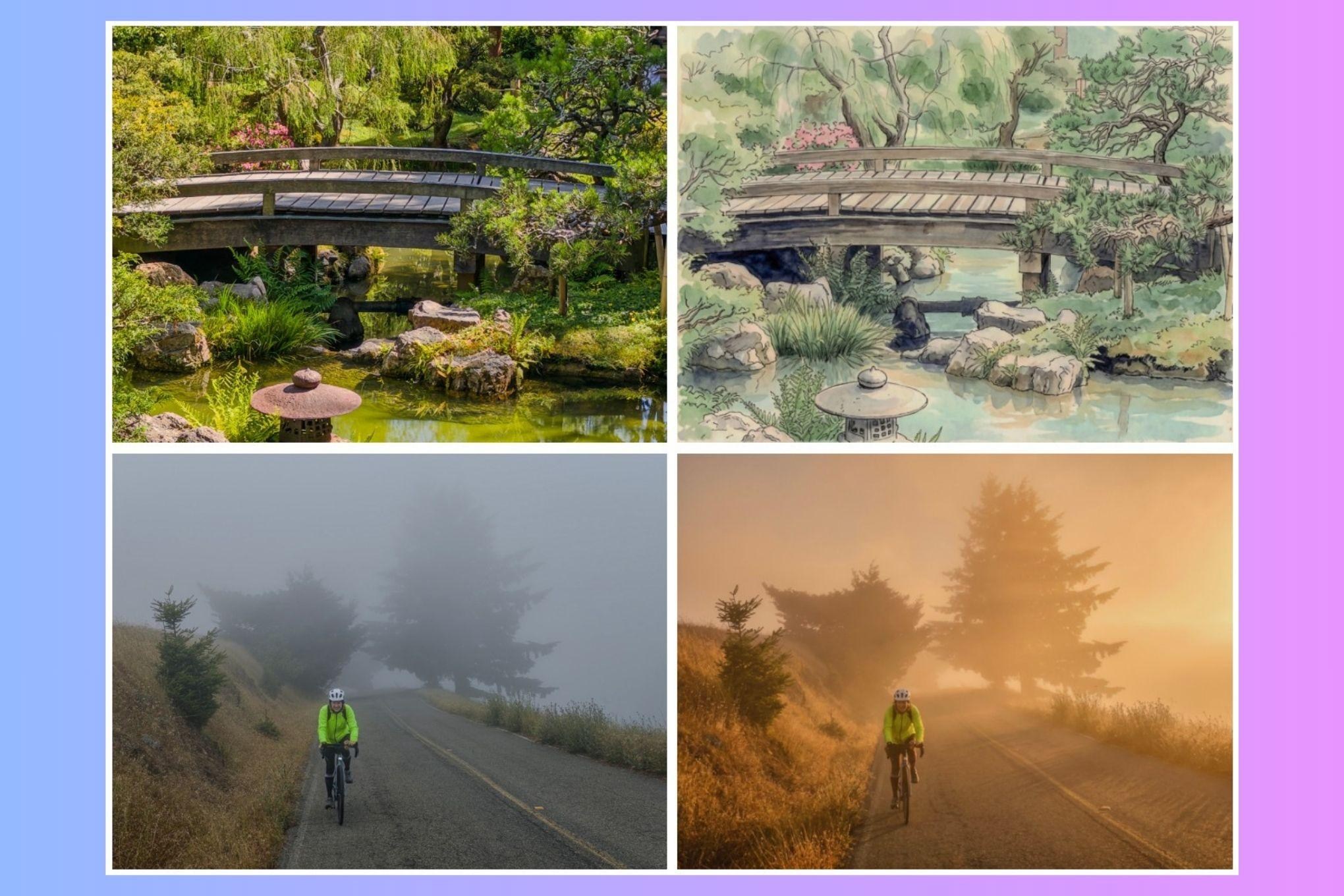
Styles applies preset AI-generated filter effects to photographs snapped using Indigo, making them look like illustrations, changing the lighting effects, and more. Object Editing includes tools that remove people, objects, and other distractions from the backgrounds of images, with generative AI then used to fill in the blank spaces left behind, similar to Google’s Magic Eraser feature. Photo Guidance is a feedback feature that allows AI to analyze your photos to provide suggestions for reshoots and editing.
The last feature, Custom Edit, is a broader prompting tool that lets users describe how they want to manipulate an image in more detail. For example, if you’re unhappy with the results of a Styles preset, Custom Edit allows you to specify what else to change. Adobe is leaning on Google’s Nano Banana AI model for this update “to start,” but says it may switch or introduce additional model support over time.
It’s a far cry from the experience that Indigo provided at launch, with my colleague Allison describing it as a “camera app built by camera nerds for camera nerds.” It uses computational photography features to help mobile photographers capture better-quality images that re-create the look of SLR photos, alongside providing manual controls like focus, shutter speed, ISO, and white balance. The introduction of generative AI editing features may have been planned from the start, however.
“This is the beginning of a journey for Adobe — towards an integrated mobile camera and editing experience that takes advantage of the latest advances in computational photography and AI,” Levoy said when the Indigo app first launched.
Notably, the experiment also lacks the same level of consideration toward AI transparency that Adobe usually exerts. Levoy says the Indigo team is working toward adding C2PA Content Credentials — a metadata standard for identifying AI content that’s already widely used by Adobe’s Firefly models — to images manipulated by Indigo’s generative AI tools and notes that Nano Banana already applies Google’s invisible SynthID watermark.
“Whether the edits you apply are ‘fair’ or ‘misleading’ depend on what you do, who you share the images with, and how you present them.” Levoy says. “In the end, nothing can be implemented that reduces the importance of behaving responsibly.”