At $679.99, the four-bay uGreen NASync DXP4800 Pro NAS is a capable mid-range NAS for creators and small teams in the Apple ecosystem, with an excellent value proposition.
uGreen has built out its NAS range quickly since entering the category. AppleInsider has covered uGreen NAS hardware before, including the DXP4800 GT.
The DXP4800 Pro sits above the GT and Plus in the four-bay lineup. It pairs a six-core Intel chip with generous memory headroom.
The pitch here is sustained performance for heavier work. Docker, virtual machines, and media processing are the target use cases.
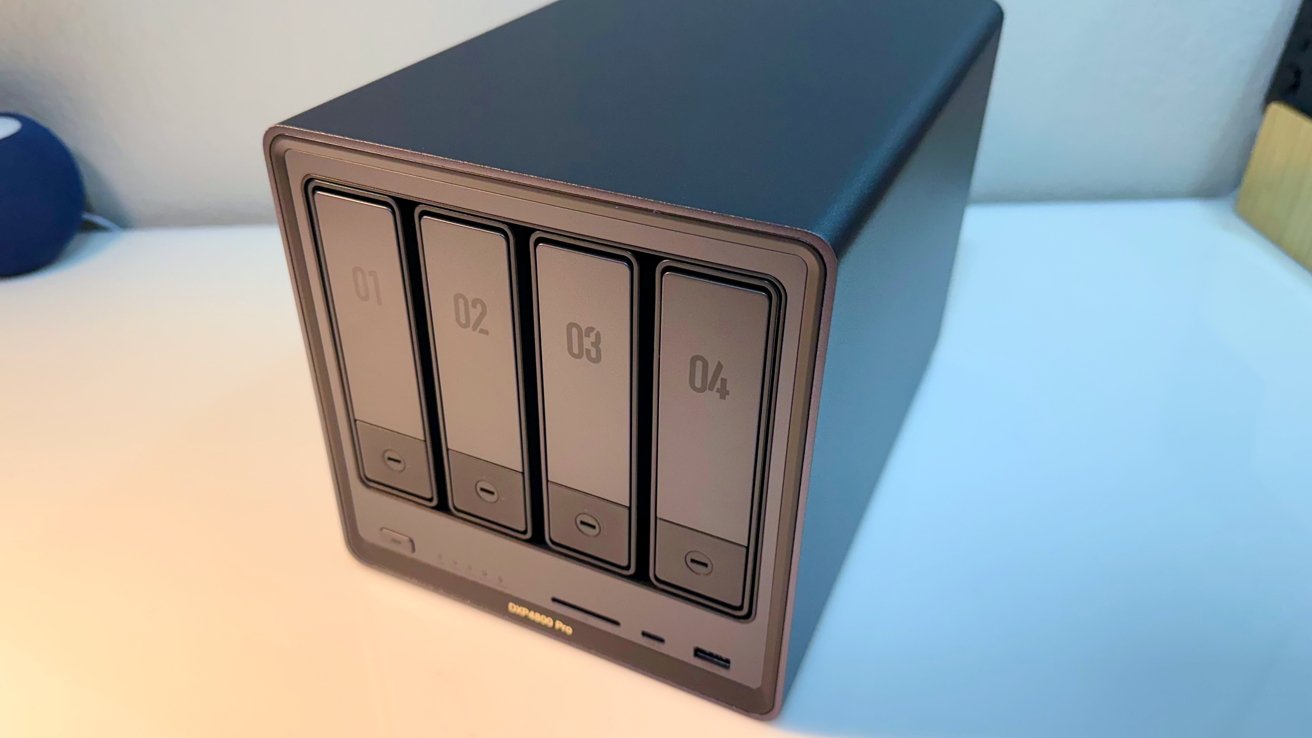
The DXP4800 Pro shares the look of its siblings. It is a grey-black four-bay box with front-loading drive trays. Nobody's going to mistake it for Apple design, but it also looks better than most in its class.
The front panel holds the power button and status LEDs. It also carries an SD card slot, a 10Gbps USB-C port, and a USB-A 10Gbps port.
uGreen NASync DXP4800 Pro review: Front ports
Those front ports make quick media imports easy. A photographer can pull card footage without reaching around the back, nor requiring a separate plug-in card reader.
There is not much else to say about the design. It's probably going to be living in your network closet, rather than on your desk.
There are six lockable drive bays at the front, numbered from left to right. They retain uGreen's normal design ethos with trays that are tool-free and hot-swappable. This remains a nice touch.
The four bays each take a SATA drive up to 32TB. That alone allows 128TB before any other storage is added.
Two M.2 NVMe slots supplement the main bays. Each takes up to an 8TB stick, adding 16TB more capacity, or caching for extra speed.
uGreen lists a total maximum of 144TB, which combines the spinning drives with the two NVMe sticks.
uGreen NASync DXP4800 Pro review: A hatch hides the NVMe slots.
The NVMe slots also deliver a real speed benefit. Data stored on them is going to be noticeably quicker to access than any stored on the SATA bays.
RAID options span JBOD, Basic, and RAID 0, 1, 5, 6, and 10. That ranges from pure speed to strong redundancy, depending on your particular needs.
uGreen NASync DXP4800 Pro review: Drive bays.
We tested the unit with four 4TB Seagate Red drives provided by Ugreen. We also used four 24TB WD Red Pro, which retail for $1,059 each on Amazon.
SSDs used for testing included a pair of Samsung 990 Evo Plus drives, and a pair of Samsung SSD 9100 Pro 1TB drives. You don't need to use drives this fast. Stick with PCI-E 3.0 drives if you have them, as they're cheaper, and still provide more than enough speed.
Networking uses one 10GbE port and one 2.5GbE port. The 10GbE is the main one you'll care about, due to the sheer amount of bandwidth available through one port.
Of course, that's assuming you have a 10-gig Ethernet network available to you.
That single 10GbE port undercuts pricier rivals on value. Many competitors charge more for equivalent 10-gigabit networking.
Usually, the addition of the second network port gives a few benefits, but link aggregation isn't really one. There's not much point to it if you already have a 10-gigabit port available to you and sufficient network infrastructure.
A more useful reason for it is to treat the two ports as independent network connections. If you have sufficient networking know-how, you could limit connectivity through specific connections for some services, while leaving the other free for others, for example.
There is a catch common to all 10GbE gear, and that is infrastructure. While you could use a 10GbE-capable Mac to enjoy the massive bandwidth, that's not immediately achievable for all.
uGreen NASync DXP4800 Pro review: Rear ports, including those two Ethernet connections.
You're more likely to find benefits from upgrading the network infrastructure to a faster speed, if budget is available. Imagine ten gigabit-class network connections all accessing the NAS through the 10GbE port on a corporate network.
The rest of the rear ports handle expansion, video, and data ingestion. There are two USB-A 2.0 ports, one USB-A 5Gbps connection, and a 4K 60Hz HDMI output.