
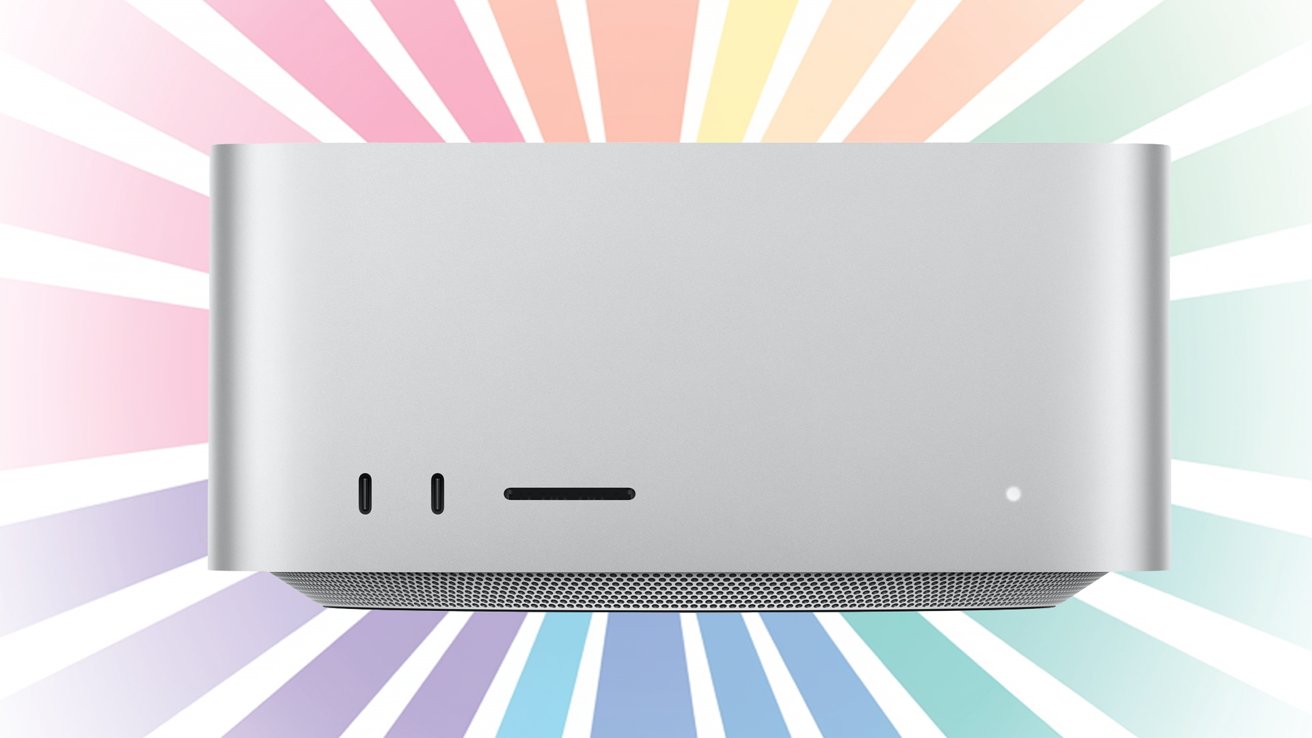
The Mac isn't selling as fast as Apple can make them because of artificial intelligence needs as some would have you believe, but AI is giving businesses plenty of reasons to buy more of them.
You may have noticed that the lead times on both the Mac mini and the Mac Studio have been a bit much over the last year or so. In fact, right now, if you wanted to buy a fully maxed-out Mac Studio, there's a 10- to 12-week wait.
There's also an $18,299 price tag before taxes. Just saying.
There's some overlap as to why both of those things are happening. A major reason is that we're seeing unprecedented supply chain constraints as both storage and memory components become harder to reliably and inexpensively source.
But there is another part of the story. And it's a story worth delving into, because it is, unfortunately, going to affect all of us in one way or another.
So let's talk about Mac mini, Mac Studio, and artificial intelligence.
Suppliers are seeing an increased demand for the Mac mini and Mac Studio. And yes, AI is definitely a reason behind why that's happening.
For some, there's this idea that Mac, especially Apple's pint-sized powerhouses, is covertly becoming the backbone of artificial intelligence.
Let me be clear here. There's an entire ocean between "AI is driving Mac demand" and "Mac is becoming foundational AI infrastructure."
Even Apple is aware of this. In fact, Apple's entire pitch is that the Mac mini and Mac Studio are perfect for doing smaller tasks, something akin to an AI-based "chore."
We've already known that this has been the case for several months. But when large AI outfits start buying up Apple's gear in bulk, it gets people talking.
According to The Information, OpenAI has purchased tens of thousands of Mac minis and Mac Studios. And Anthropic leases its Mac minis through Amazon Web Services.
But if these Macs aren't being used for infrastructure, even when purchased in bulk like this, what are they actually being used for?
OpenAI isn't chaining a bunch of Mac minis together to make a supercomputer, and there are no obvious plans to do so. That doesn't, however, mean that there's not an Apple-shaped spot in the pipeline.
One of the best things about a Mac mini, and this goes doubly for a Mac Studio, is that it's a lot of energy-efficient computing power in a small footprint. This makes them ideal for hyper-specific use cases that require a lot of repetition.
One such use is reinforcement learning, a process in which AI needs to learn through trial and error. As IBM explains, "In reinforcement learning, autonomous agents learn to perform a task by trial and error in the absence of any guidance from a human user. It particularly addresses sequential decision-making problems in uncertain environments…"
There are a lot of reasons to do this on a Mac mini or Mac Studio. Power is part of it, sure, but the other part is that AI is going to need to learn to interface with macOS anyway, and this is an economical way of doing it.
A fully maxed out Apple Studio currently costs $18,299 before taxes. Don't worry, it can (and will) get more expensive.
And yes, there are a few instances of companies clustering Mac hardware together. The Information found that Mount Thor is building a Mac-based Neocloud, and EXO Labs software does allow multiple Macs to run models too large for an individual machine.
These are pretty niche applications at the moment. And they're certainly not indicative of a broader shift in AI infrastructure.
Apple isn't positioned to displace what Nvidia can offer at scale. Nvidia makes purpose-built hardware for the massive, interconnected computing systems. Apple makes the Mac mini, a desktop-class computer you can put into your back pocket.
But that doesn't mean that Apple can't ruffle Nvidia's feathers elsewhere.
MacStadium surveyed about 300 U.S-based developers in the mid-market and enterprise organizations to find out just what they were using their Mac mini and Mac Studios for. And it is the exact thing that I've personally suspected for a long time:
Mac developers want to use a Mac to develop for the Mac. They aren't using the 16GB Mac mini for big AI loads, and the starting SSD space is too small for anything serious
Historically, we know that the entry-level Mac mini is about 80% of the sales of the model. That was the same through the entire M4 Mac mini run. The entry-level model was just as constrained for most of 2026 as the upgraded configurations or the M4 Pro Mac mini.
Most of these outfits are pretty small, with 80% falling somewhere between 5 and 50 engineers. But they're running a surprising amount of hardware; 55% of the teams surveyed use 26 or more physical Macs for continuous integration/continuous deployment (CI/CD).
CI/CD is, in layman's terms at least, the automated process of taking developers' code, building and testing it, and ultimately preparing it for release. And because these teams develop for Apple platforms, that process requires access to Mac hardware.
One pretty critical point here is that even though these engineers are using Macs, most aren't primarily relying on self-hosted AI. More than a third are using hosted AI services like OpenAI or Claude.