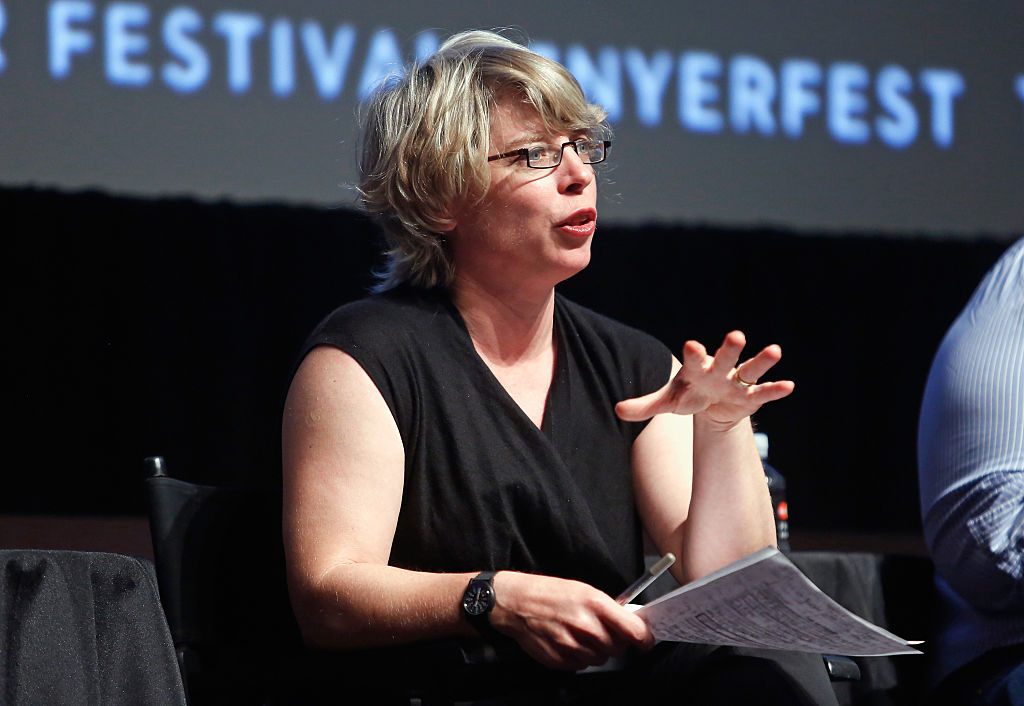
In her upcoming book “The Rise and Fall of the Artificial State,” Jill Lepore warns that tech companies are increasingly replacing the functions of democratic government. This shift, she said, marks “a return to tyranny and mystification in the form of rule by algorithms, corporations, machines.”
On the latest episode of TechCrunch’s Equity podcast, I spoke to Lepore — a Harvard historian and New Yorker staff writer who recently won a Pulitzer Prize for her history of the U.S. Constitution — about the evolution of what she described as “the idea that we should live under an artificial state or government by machines.”
“I’m not an anti-technologist,” Lepore insisted. Instead, she said, “My beef is the ways in which private corporations have increasingly taken on the functions of the state.”
While Lepore’s book examines technocratic philosophies that go back centuries, she argued that many of Silicon Valley’s “charismatic or not-so-charismatic leaders” — especially Elon Musk — seem to be ushering in a future pulled from misread pulp science fiction and comic books.
“But what’s funny about Musk is, the stuff he likes actually completely defeats and defies all of his political beliefs,” she said.
Our conversation also covered Apple’s famous “1984” Macintosh ad, why it’s “bananas” to call Twitter a digital town hall, and the current data center backlash. Keep reading for highlights, edited for length and clarity.
So you’ve probably had to do this a lot already, but can you explain what you mean by the “artificial state”?
By the artificial state, I mean a kind of state that is replacing the liberal democratic nation-state in the United States and around the world. It’s both a real thing, a construct, but it’s also an idea.
And so, in this book “The Rise and Fall of the Artificial State,” I trace the rise of the idea that we should live under an artificial state or government by machines. I also trace the notion that this is an inevitable failure, that the artificial state cannot survive, and I trace that idea through science fiction.
At one point, you say the rise of the artificial state marks the end of centuries of democracy and equal rights, and it’s “a return to tyranny and mystification in the form of rule by algorithms, corporations, machines.” Can you just say a little bit more about why you see it in such stark terms?
Yeah, I do have a pretty negative view of it, and I think it’s important to distinguish the artificial state from technology itself or modes of technology. I’m not an anti-technologist. I’m married to a computer scientist. I’m really excited about all kinds of intellectual revolutions that we’re in the midst of right now.
That’s not my beef, right? My beef is the ways in which private corporations have increasingly taken on the functions of the state. No one consented to that. This has been a kind of gradual, largely accidental transformation of how many nation-states around the world work — it’s happened first in the United States.
I think often these innovations in bringing new technologies to the operations of government have been extremely well intentioned; they originate with an interest in efficiency and speed and cheapness. And then, I think, only in the last 20, 25 years or so have these decisions been purposeful and deliberate as a kind of usurpation of the role of the nation-state.
And that’s not my speculation. You hear a lot of a lot of very prominent tech entrepreneurs talk about wanting to move beyond the era of the nation-state. […] A lot of futurists in the ’90s were libertarians, and they had a specific interest in using the advance of the internet and the successive innovations that followed as a means to eradicate the nation-state.
You talk about, on the one hand, the technologies themselves, and then also the philosophies behind them, the role the corporation has increasingly played. I’m curious to what extent we can separate them. Can we actually have a version of the internet and of social media that doesn’t necessarily lead to this future that it seems like we’re [currently] hurtling towards?
Absolutely. I’m a historian. I’m not a tech writer. I’m not a tech journalist. I’m not a computer scientist. I’m a historian, and I’m chiefly a political historian, though I’m also a literary historian. And so, one of the things that I’m really interested in unraveling for readers in this book is all the what-ifs, all the alternatives, the paths along the road that were not taken and why.
There was, of course, a really avid discussion in the 1990s about what the internet should look like when it was opened up, and what we ended up with, the 1996 Telecommunications Act — I think, a lot of people would say [that] just was a mistake, not an act of sinister intent, right?
But it was a product of a particular political moment, really was deeply influenced by Newt Gingrich and his Contract with America, and it’s been very difficult to revisit. I think it’s worth thinking about what were the alternatives that were in play at the time.
And you could say the same thing about the personal computer. So, to the degree that we can locate an origin point for the promise that better computer technology would make for better democracies, I think the moment you would first look to would be January 1984, that Super Bowl ad that Apple ran for the release of the Macintosh, with the the sort of George Orwell, 1984 [theme]. Apple was really big on the idea that mainframe computers represented totalitarianism. They were trying to dismantle the giant gray IBM machines, as in representing them in that ad as a totalitarian state. And the lithe, beautiful, quick, adorable, personal Macintosh would be the ax that would destroy that machine and would usher in a new era in which “1984 would not be ‘1984.’”
That was clever advertising. I doubt that anybody at Apple really believed the personal computer was going to be an instrument of personal liberation. I mean, it was going to make possible a lot of cool things. I remember when I got my first Macintosh — it certainly wasn’t 1984, but it was really cool, it was really fun, it was really exciting, I did a lot of things on it. It would never occur to me that it was improving my capacity for citizenship or my ability to function better in civil society. It was a cool tool.
But if you wind the reel forward in time, down to 2026 — stops along the way include the 2016 election when Facebook News, in response to its critics, establishes a Supreme Court. You get to last year, when Anthropic hired a moral philosopher to write a constitution. You get to recently, when Sam Altman was on Joe Rogan and said [in response to a question from Rogan], “Oh, an AI president would be a great idea.”
In some ways, they’re silly examples. But you see the ways in which these corporations, these tech companies from Silicon Valley, and especially their charismatic or not-so-charismatic leaders, are just taking on the trappings of the nation-state and the functions of democracy.
They’re not people with a sophisticated political philosophy, but it’s like a cartoon version of that 1984 Macintosh ad, except that it takes itself so seriously. And these companies have so much power.
But that said, the book doesn’t begin in 1984. I just think that’s a good example of our modern era and the way a fun advertising campaign turns into a kind of delusional fantasy on the part of people like Sam Altman.
You [also] talk about the promise of the quote-unquote “Twitter revolution,” and this idea that it would bring democracy everywhere. I can’t help but let that color the way I [react] when Sam Altman or some other AI CEO now says that AI is going to bring all these incredible gifts — and therefore, if you stand in the way, you’re standing in the way of progress, in the way of history.
To what extent should we just dismiss all these claims out-of-hand, or are there ways that it might come true?
I mean, Twitter is actually a good example, right? When it was launched, when Jack Dorsey started it, it didn’t announce itself as, “We’re going to save humanity, we’re going to rescue human civilization from extinction.” It was kind of a goof, and I think people that used Twitter really early on were like, “You know what? It was actually really fun.” It was like, “I made a tuna fish sandwich today. What did you have for lunch?” Twitter as a company did not launch itself on a stage saying, “We’re here to save democracy.”
And really, what happened was that politicians, elected officials began using Twitter in ways that enhanced their political power, in ways that amplified their messages, in ways that allowed them to reach a younger audience, in ways that allowed them to have a constant connection with an audience. Politicians and political campaigns really kind of convinced Twitter — at least insofar as I see them, I don’t have an inside account of the company — but somewhat begrudgingly, Twitter came around to like, “Twitter’s gotten so big, and people post about politics so often that it’s almost like Twitter is a town hall.”