
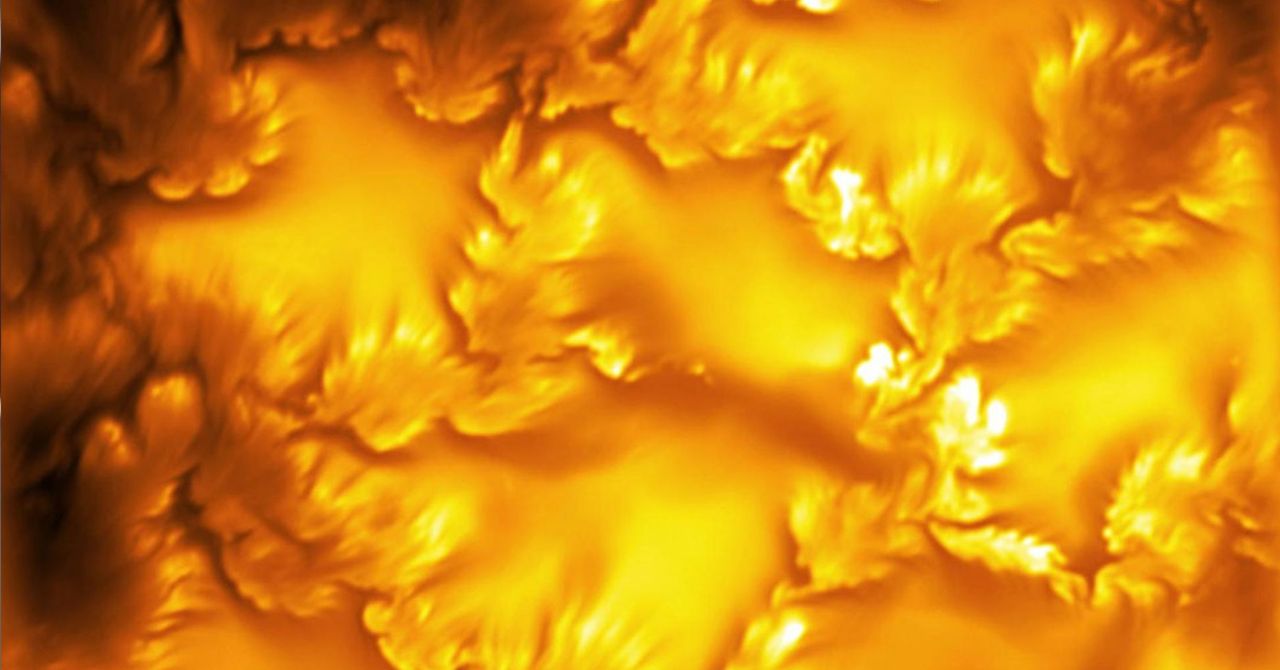
For decades, scientists had theorized that the sun’s surface must be crisscrossed by tiny plasma vortices, generated by the interaction between its intense magnetic fields and the constantly flowing superheated material. This week, the world’s most powerful solar telescope has just confirmed this.
The latest image captured by the Daniel K. Inouye Solar Telescope, located at the summit of Haleakalā volcano in Hawaii, shows for the first time evidence of the so-called Kelvin-Helmholtz instability, a physical phenomenon first predicted more than a century ago.
The image, shared by NASA, is not the most spectacular view of the sun, but it is one of the closest to how the human eye would see it if it could withstand the intense brightness. Unlike the famous photographs in shades of blue, green, or orange captured by space observatories using ultraviolet or X-ray radiation—wavelengths invisible to us—this image was captured in visible light. As a result, it reveals a landscape reminiscent of petals, swirls, and folds on the star’s surface.
A full image of a section of the sun’s surface, viewed with unprecedented resolution in visible light.
The “petals” appearing in the image are generated by the Kelvin-Helmholtz instability. This occurs when two fluid currents move at different speeds. The friction between the two causes the boundary to ripple and form swirling patterns. The Kelvin-Helmholtz instability is not unique to the sun. It also occurs on Earth, for example, when wind blows over water or in clouds.
In the sun, the fluids are plasma streams—a state of matter in which gas is so hot that its atoms lose electrons. Scientists expected that, in certain regions of the sun, these plasma streams would behave just like two streams of air or water colliding with each other, forming vortices.
Until now, visible-light telescopes provided a seemingly smooth view of the sun. Thanks to the techniques used by the Inouye telescope, scientists were able to observe what is happening on its surface in much greater detail. Small vortices, barely a few dozen kilometers in diameter, are constantly forming and disappearing. These structures have always been there. We have only recently learned how to visualize them.
According to NASA, this image spans approximately the Earth’s radius and is the highest-resolution image available in visible light. The unprecedented details will provide a better understanding of how the sun transfers its energy to outer regions and how it alters the temperature of its solar corona. The solar corona is of great scientific interest, as it is the source of coronal mass ejections—the phenomena responsible for geomagnetic storms that threaten the world’s electronic systems.
This story originally appeared in WIRED en Español and has been translated from Spanish.