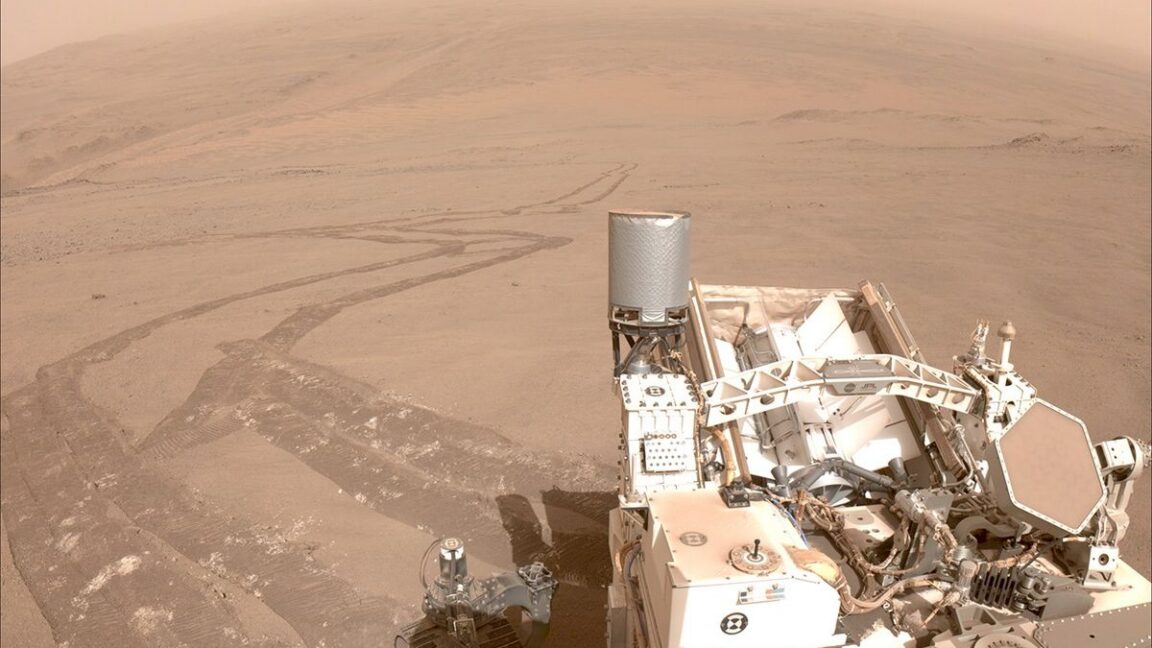
Sometime next week, NASA’s newest rover on Mars, Perseverance, will set a record for the most distance driven by any vehicle on another world.
The automobile-sized rover, which landed on Mars in February 2021, will traverse beyond 45.16 km (28.06 miles) across the Martian surface. In doing so it will break the previous distance record held by the long-lived Opportunity rover, which ceased communications with NASA in 2018.
So how did Perseverance reach this record-setting distance in just a third of the time?
“The real enabling technology has been its auto navigation system,” said Steven Lee, the project manager for the Perseverance rover at NASA’s Jet Propulsion Laboratory, in an interview.
Much like self-driving cars on Earth, Perseverance has sophisticated onboard cameras that image the surrounding terrain, and these images are then processed algorithmically by an onboard computer to calculate the safest route. Terrestrial vehicles have some advantages of course, like clearly defined maps, street signs, lanes, and more. Additionally there are plenty of “road” hazards on Mars, from large boulders to sandy slopes. But at least Perseverance does not have to contend with other traffic and bad drivers.
The Curiosity rover, largely a twin of Perseverance that launched nine years earlier, had similar imaging capability and algorithms. But its onboard computer was a generation older, and some of its chipset dated back to the 1990s, Lee said. As a result, only about 10 percent of Curiosity’s driving is autonomous because its processing capabilities are too slow. In its decade and a half on Mars, Curiosity has driven 38.6 km.
By contrast, about 90 percent of the distance driven by Perseverance has been autonomous thanks to its (slightly) more modern Vision Compute Element. This allows the vehicle to perform all of its sensing and computation while its wheels are turning. Not that the vehicle is going super fast, as Perseverance’s maximum wheel speed is about 150 meters per hour.
Still, because Perseverance has not had to spend much time stopped to wait for navigation commands from drivers on Earth, the vehicle has been able to maximize the amount of scientific return.
“It is very enabling for the science,” said Vivian Sun, the mission’s deputy project scientist. “Not to sell the rover’s other advanced capabilities short, but the driving in particular has allowed us to have a larger scope than previous missions.”
Perseverance’s self-driving ability has nicely complemented its mission. Curiosity landed in Gale Crater and has slowly been making its way up Mount Sharp. It moves less and spends more time systematically taking detailed measurements as it gains altitude. Perseverance, however, landed in Jezero Crater, where its science objectives are more spread out. It has been able to cruise from one location to another, often surprising scientists by turning up at a new site ahead of the planned timeline.
And that’s good, because there is a lot of work to do. In Jezero Crater, the rover is studying some of the most ancient rocks in the Solar System, older than any on Earth, dating as far back as about 4 billion years ago. At the time, the planet was in the later stages of the “heavy bombardment” era when rocks were still whizzing around the inner planets in great numbers. But things were starting to settle down.
“It’s the first time we’ve been able to investigate this terrain in situ, and that’s been very exciting,” Sun said.
During this era, large lakes and possibly even oceans are thought to have existed on Mars. Perseverance is exploring this ancient terrain to better understand what geological and environmental conditions might have existed at the time, and just how conducive the planet might have been to life. Scientists believe the planet might have looked something like the Mojave Desert on Earth, with water flowing through it, but the debate rages on. With Perseverance, there is a lot of data to base it upon.
Curiosity is still going strong on Mars after nearly 15 years, and Perseverance operators say the newer rover is doing great as well. After a few years on Mars, Curiosity operators noted significant wear and tear on the vehicle’s wheels. So for Perseverance, the wheels were redesigned, and there are no signs of appreciable wear and tear, Lee said.
The only minor concern at this point is the actuators in the wheels. They were initially life-tested for 20 km of driving, but NASA is in the midst of certifying them to at least 100 km, and possibly longer. Perseverance operates on RTG power and has no propellants, consumables, or lubricants on board.
For this reason, Lee said, the vehicle could keep driving itself across Mars for many years to come.